
What Drives the Cost of a Custom Mannequin
Tooling, fabric, wooden arms, bases, quantity, sampling and freight: the seven factors that actually move a custom mannequin quotation, and how to shape a brief so the price lands where the budget is.
The first question most buyers ask a mannequin manufacturer is the price. The honest answer is that a custom mannequin does not have a price until the specification is settled, because the same silhouette can be built at very different cost levels depending on how it is finished, what it is fitted with and how many are made.
This guide explains the factors that actually move a quotation up or down, roughly in order of how much they matter. It is written for brand buyers, store planners and visual merchandising teams who want to understand a quote — or shape a brief so the quote lands where the budget is — rather than a list of prices, which would be out of date and meaningless without a specification.
1. Whether the form is new tooling or an existing silhouette
The single largest cost driver is whether the body shape already exists. A mannequin is made from a mould, and a new mould has to be sculpted, corrected, approved and produced before a single form comes out of it. That development work is a fixed cost, so on a small order it dominates the unit price; on a large one it almost disappears.
Most “custom” mannequin projects do not need a new body. They use an existing silhouette from the manufacturer’s range and customise everything a customer actually sees — fabric, colour, arms, head, base and finish. That approach removes the tooling cost entirely and shortens lead time by weeks. Reserve new tooling for cases where the proportions themselves are the point: a house fit standard, a distinctive posture, or a size the range does not cover.
2. Fabric type and covering work
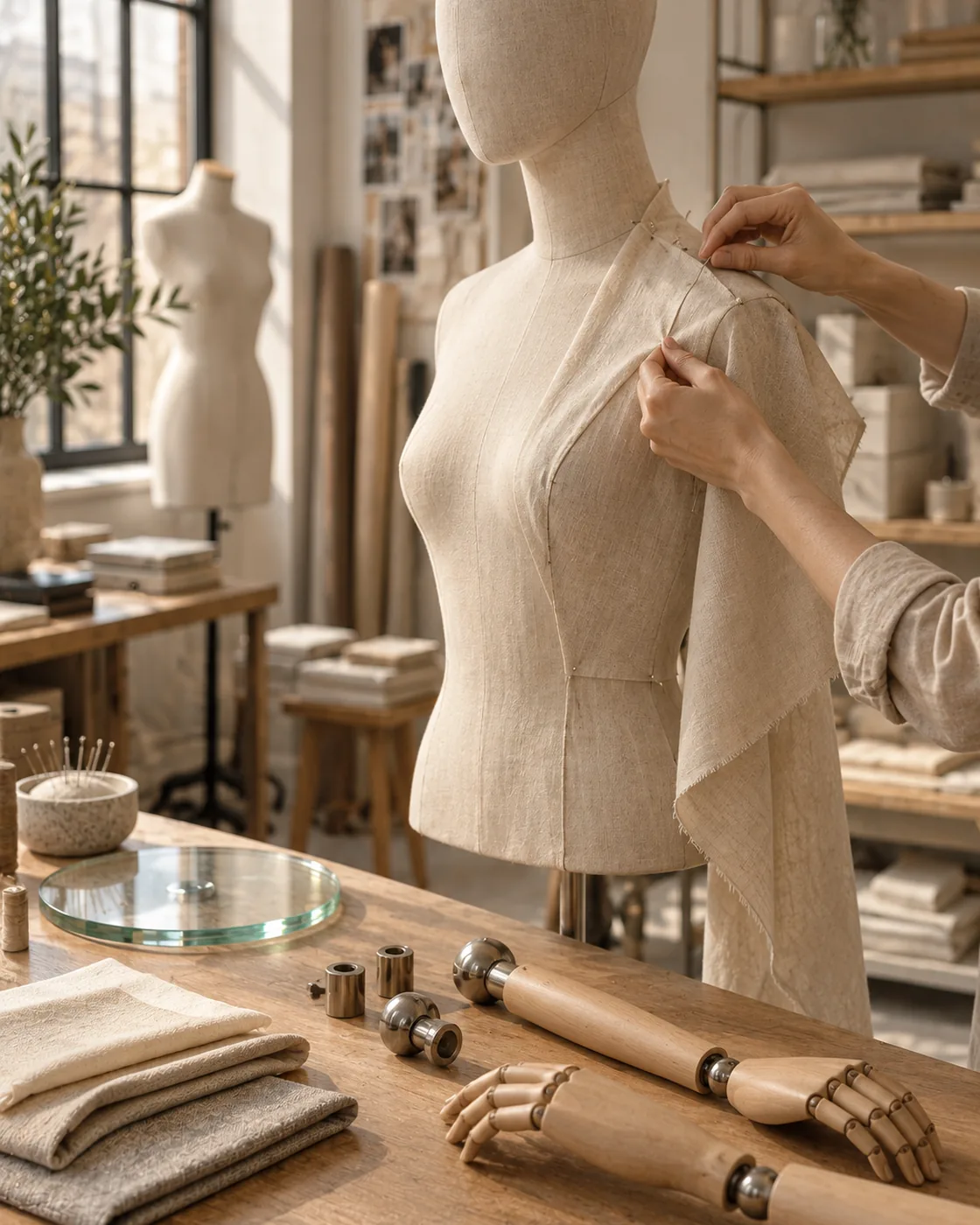
For a fabric-covered mannequin, the covering is the most skilled part of the build. The fabric is stretched, cut and hand-sewn onto the shell so that seams fall in consistent places and the surface is smooth over curves. Cost here moves with three things:
- The fabric itself. A standard linen or cotton blend from the manufacturer’s stock costs less than a specified fabric sourced to match a brand colour, and far less than a customer-supplied luxury textile.
- Pattern and direction. A plain weave is forgiving. A visible texture, stripe or nap has to be aligned across every panel, which takes more time and more fabric.
- Coverage. A full-body form takes considerably more covering work than a torso, and separate head and arm covering adds to it again.
Our guide to custom mannequin finishes walks through the fabric, paint and hardware options and what each involves in production.
3. Arms, heads and articulation
Fittings are the second place where two forms of the same shape diverge in price. Fixed, covered arms are the simplest. Adjustable wooden arms — jointed at the shoulder, elbow and wrist — are made from solid timber, shaped, finished and fitted with joint hardware, and they add meaningfully to the cost of each form. They also add flexibility that fixed arms cannot offer, which is why they are standard for premium brands whose displays change often; the trade-off is explained in our wooden arms guide.
Heads follow the same logic. A form without a head is cheapest; a covered egg head adds covering work; a wooden or sculpted head adds material and finishing. Each option is legitimate — the question is what the display needs, not what is most elaborate.
4. Base and hardware
The base is easy to overlook in a quote and easy to overspend on. A standard round glass or steel base plate with a calf or foot fitting is the baseline. Costs rise with custom shapes, brushed or plated finishes, heavier plates for tall forms, and specialised fittings such as heel rods for footwear display. Because bases are often the first thing damaged and the easiest to replace, it is worth asking for the base to be quoted as a separate line so you can see what it contributes. Our bases and stands guide covers the options.
5. Order quantity
Quantity affects unit cost in two ways. The obvious one is that fixed costs — sampling, any tooling, fabric sourcing, set-up — are spread across more units. The less obvious one is production efficiency: covering twenty forms in the same fabric is faster per unit than covering three, because the team is not switching materials and patterns.
Most manufacturers set a minimum order for genuinely custom work and price steps at quantity breaks. If your programme is phased across stores or seasons, say so at the quotation stage; it is usually possible to price the whole programme and release it in batches. Our article on MOQ, samples and lead times explains how these terms typically work, and our wholesale buying guide covers multi-store planning.
6. Sampling and approval
A custom order normally starts with a sample: one form built to the specification for approval before bulk production. Sampling has a cost because it is a one-off build with all the set-up of a production run and none of the volume. It is also the cheapest insurance in the whole process — a colour or proportion problem found on one sample costs a fraction of the same problem found on a hundred forms.
The approved sample is normally kept at the factory as the reference for the bulk order; if you want a confirmation piece for your own records, ask for it and the manufacturer will keep a matching one. Sample cost is often credited against the production order, so check the quotation for that.
7. Packing and freight
Mannequins are bulky, fragile and light for their size, which is the worst combination for shipping — freight is charged on volume, not weight. A full-body form with arms and base needs a protective carton with internal supports, and the carton dimensions largely determine sea or air freight cost. Torso forms and detachable components pack far more efficiently. On small orders shipped far, freight can be a large share of the delivered cost, so it is worth discussing with the manufacturer how the forms will be packed and whether components can be consolidated. Our international shipping guide covers what to expect.
What does not change the price as much as buyers expect
- Fabric colour, if chosen from the manufacturer’s stock range. A colour the factory already holds costs the same as any other; a colour that has to be sourced does not.
- Removable versus fixed heads, which is mostly a hardware detail.
- Branding on the base, such as an etched or printed logo, which is a modest addition once the artwork exists.
Reading a quotation
A useful quotation breaks the price into components — form, covering, arms, head, base, packing — rather than a single number. That lets you see where the cost sits and adjust the brief intelligently: switching from a custom-sourced fabric to a stock one, say, or reducing a mould charge by using an existing silhouette. If a supplier will only give you a total, ask why. Our guide to buying direct from a manufacturer rather than a trading company explains how the layers between you and the factory affect both price and transparency.
Finally, consider cost over the life of the form rather than at purchase. A fabric-covered mannequin with replaceable arms and a base that can be swapped will typically be re-covered and refreshed rather than discarded, which changes the arithmetic considerably over five or more years. See our article on repair and refurbishment for how that works in practice.
Getting an accurate quote
The fastest way to a reliable quotation is a clear brief: form type and quantity, fabric preference, arm and head configuration, base type, destination and timing. With that information a manufacturer can quote within days rather than trading questions for weeks. We are happy to quote against a specification or to help you build one — send your requirements through WhatsApp or the quote form and we will respond with an itemised proposal.