
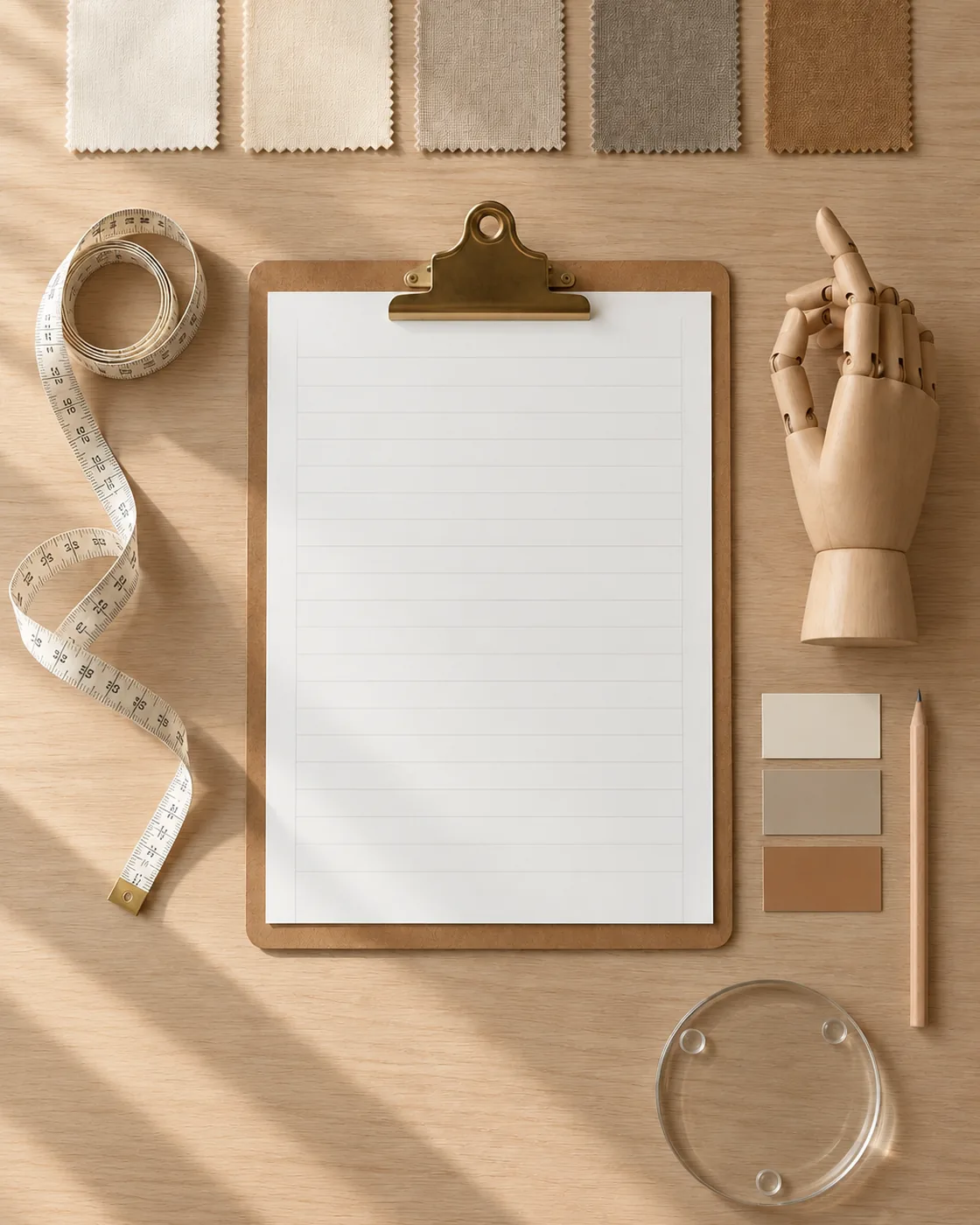
Custom Mannequin Specifications: How to Brief a Manufacturer
A ten-point checklist for briefing a mannequin manufacturer — setting, form type, size, fabric, arms and head, base, posture, quality standards, samples and delivery — plus a one-page template, so the quote is accurate and the first sample is right.
Most delays in a custom mannequin project happen before production starts. The manufacturer receives a request for “twenty female mannequins, fabric-covered, with wooden arms”, sends back a page of questions, waits a week for answers, and sends back another page. By the time the specification is complete, a month has gone and the store opening has not moved.
A good brief removes that month. This guide sets out what a manufacturer needs to know to quote accurately and build the right form the first time, in the order a factory will actually ask for it. Use it as a checklist when preparing a request for quotation, whether you are ordering three forms for a boutique or three hundred for a roll-out.
1. Purpose and setting
Start with where the forms will stand and what they will wear, because everything else follows from it. State:
- Whether the forms are for shop floor, windows, showroom, trade show or photography — each pushes the specification differently. Window forms, for example, need fade-resistant fabric and more articulation than floor forms.
- The garment categories: tailoring, knitwear, dresses, outerwear, sportswear, lingerie. Fit and posture requirements differ.
- The interior palette and materials, ideally with a photograph or render of the store, so fabric colour can be chosen against the real backdrop.
This is also where to say whether the forms are display mannequins or something else. Fabric-covered display mannequins are built to present finished garments; they are not dress forms for pattern-making and draping, which are a different product with different construction. Our dress forms explained article covers the distinction if it is unclear.
2. Form type and quantity
List each form type separately with its quantity. A typical line reads: “Female full-body, standing, 12 units; female torso on base, 8 units; male full-body, 6 units.” Quantity per type matters because minimums and price breaks apply per type, not per order. If the programme is phased across stores or seasons, give the total and the release schedule; it is usually possible to quote the whole and deliver in batches. See our note on MOQ, samples and lead times for how those terms work.
3. Size and proportions
State the garment size the forms should fit — a sample size, a specific size from your grading, or a regional standard — and the finished height including the base. If you have a house fit standard, send the measurement chart: bust or chest, waist, hip, shoulder width, neck, back length and any others you grade to. If you do not, say which of the manufacturer’s standard sizes you expect to use and ask for their chart.
Height is a common source of error. A form quoted at 178 cm may be body-only or may include a 15 cm base; make sure both parties are measuring the same thing. Our mannequin size guide explains how form measurements relate to garment fit.
4. Body construction
For a fabric-covered mannequin, specify the shell and covering:
- Shell: the manufacturer’s standard is normally a rigid body covered directly in fabric. Some buyers ask for a soft layer under the fabric for a rounder handle; if you want that, say so, as it is not standard and changes the build.
- Fabric: the fibre and weight (linen, cotton, linen-cotton blend, wool-look, velvet), whether from the factory’s stock range or supplied by you, and a colour reference. A Pantone or physical swatch is far more reliable than a name like “warm ivory”.
- Seams: whether seam placement should follow the manufacturer’s standard pattern or a specified layout, and whether seams should be visible or minimised.
Note that fabric-covered display forms take a pin inserted at an angle to secure accessories such as eyewear; they are not designed for pinning garments to fit. If the display requires garments to be pinned or tucked, say so and the manufacturer can advise.
5. Arms, hands and head
This section drives both cost and function, so be specific:
- Arms: fixed covered arms, or adjustable wooden arms jointed at shoulder, elbow and wrist. For wooden arms, state the timber finish — natural, stained, painted — and whether left and right must be interchangeable.
- Hands: wooden articulated, carved fixed, or none.
- Head: none, covered egg head, or wooden head; removable or fixed; and whether any facial detail or hairline is wanted.
Our guide to mannequins with wooden arms explains what the joints do and which configurations suit which displays.
6. Base and fitting
Specify the base material and shape (round glass, square steel, timber block), its finish (clear, brushed, black, plated), the fitting point (calf, foot, heel rod) and whether the form must be repositionable by one person. If bases will carry a logo, supply the artwork. If forms will stand on a plinth or in a window with a fixed height, give that dimension so total height can be checked. Our bases and stands guide sets out the options.
7. Posture
Describe the stance — straight, weight on one leg, slight turn of the torso, head straight or angled — or, better, send reference photographs. If the set is to include a seated or leaning form, say so early, as those are separate silhouettes. Where forms have adjustable arms, posture can be finalised in store, which is one of their main advantages.
8. Finish standards and quality checks
Say what you will inspect and what you will reject. Typical items: fabric tension and absence of wrinkles, seam straightness, colour consistency across the batch, joint stiffness and holding strength, base stability, and freedom from marks. If you have a quality standard from a previous supplier, share it. Our eight pre-shipment checks are a reasonable starting point.
9. Samples and approval process
State whether you require a pre-production sample, how many, and who signs it off. The approved sample is normally kept at the factory as the reference for bulk; if you want a confirmation piece sent to you as well, request it and the factory will retain a matching one. Agree what happens if the sample needs changes — a second sample, or approval on photographs of the correction.
10. Packing, delivery and timing
Give the delivery address or port, the required arrival date, and whether the forms ship assembled or with arms, heads and bases packed separately. Say whether cartons need store-level labelling for a multi-site roll-out. If timing is fixed by a store opening, state the date and work back; a manufacturer can tell you quickly whether it is achievable and where the risk lies. See our shipping guide for what international delivery involves.
A one-page brief template
| Section | What to include |
|---|---|
| Project | Brand, store or programme, number of sites, opening or launch date |
| Setting | Floor / window / showroom / photography; garment categories; store photos |
| Forms | Type and quantity per line; phasing if any |
| Size | Garment size to fit; measurement chart; total height with base |
| Body | Shell, fabric fibre and weight, colour reference, seam preference |
| Fittings | Arms, hands, head — type, finish, removable or fixed |
| Base | Material, shape, finish, fitting point, branding artwork |
| Posture | Description or reference photographs |
| Quality | Inspection points and acceptance standard |
| Samples | Number, sign-off, confirmation piece required or not |
| Delivery | Destination, date, packing and labelling requirements |
What a complete brief gets you
With this information a manufacturer can quote itemised, confirm feasibility and lead time, and start on a sample without a round of clarification. It also protects you: a written specification is what the sample and the bulk order are checked against, and it is the document that resolves any disagreement later. If you are evaluating suppliers at the same time, our guide on how to choose a custom mannequin manufacturer covers what to look for.
We work from briefs like this every week and are glad to help fill in the gaps — if you have a store photograph, a garment size and a rough quantity, that is enough to begin. Send it through WhatsApp or the quote form and we will come back with the questions that remain and a proposed specification.