
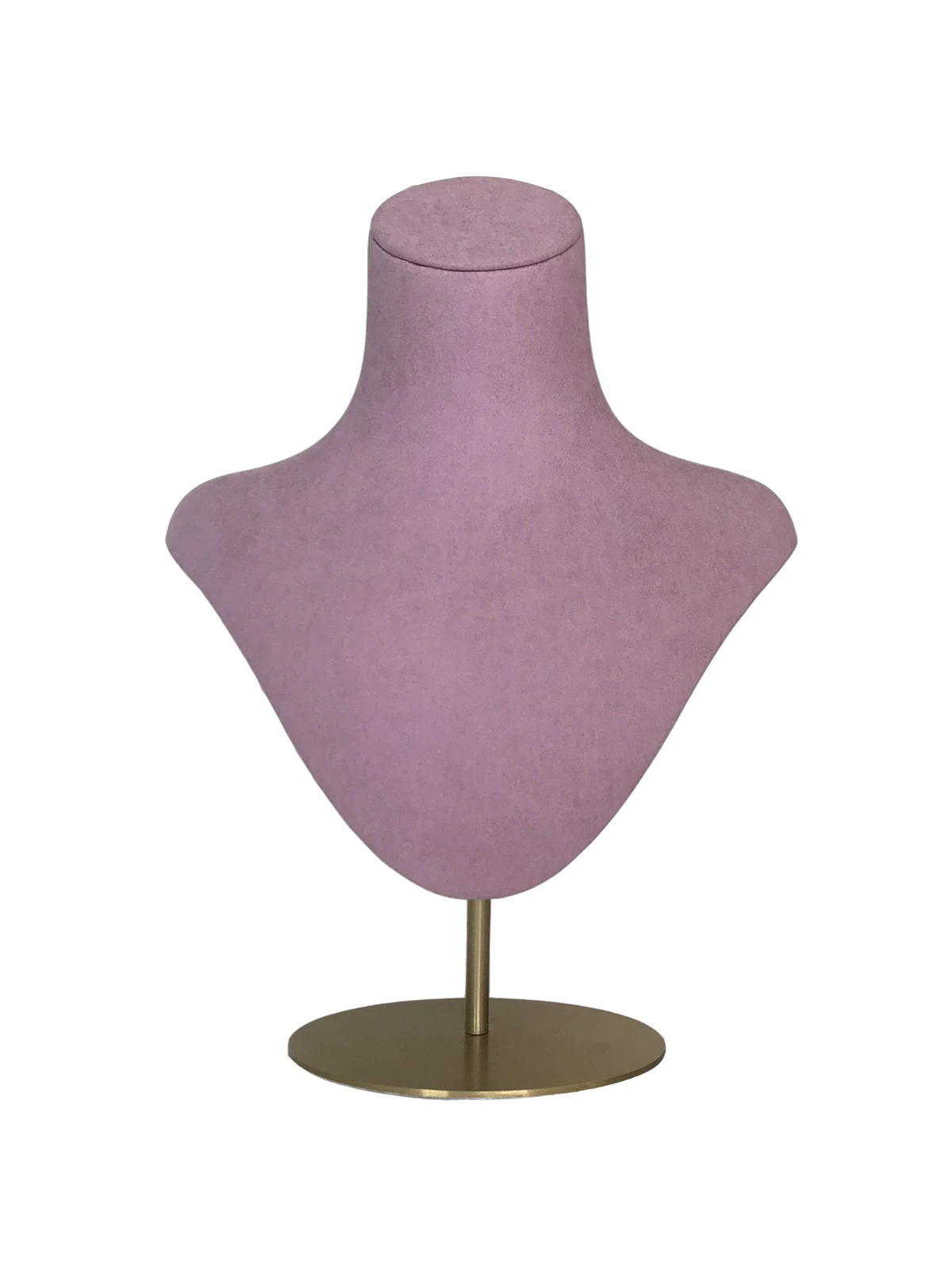
Necklace Display Busts: Choosing Size, Shape and Surface
Choose necklace display busts by chain drop, pendant position, showcase clearance and material compatibility, with a practical jewelry sample checklist.
A necklace display bust should support the chain’s natural drape, keep the pendant visible and fit the showcase at the customer’s viewing angle. Choose its neck circumference, chest height and surface using your actual jewelry, rather than selecting a bust only by color or overall height.
A compact bust can make a short necklace look balanced while leaving a long pendant below its lower edge. A tall form may accommodate that pendant but obstruct the case behind it. This guide helps jewelry and accessory retailers specify the relationship between the necklace, the display surface and the surrounding cabinet.
How does a necklace bust differ from a display head?
A necklace bust provides a neck and chest area without necessarily including a head. Its chest controls the chain’s path and gives pendants a background. A full display head adds visual context for hats, scarves or eyewear, but can take attention and vertical space away from jewelry.
If your assortment combines headwear and accessories, compare the formats in our display head guide. For a necklace-led counter, assess the bust on how well customers can see and compare the products.
Measure the necklace as it will be displayed
Record the clasp setting used in the display, the pendant dimensions and the desired visible position. Chain length alone does not predict pendant position on every bust: neck circumference, shoulder width and the chest angle change how the chain sits.
| Specification | Why it matters | Sample check |
|---|---|---|
| Neck circumference and contour | Controls the route and opening of shorter chains | The chain sits without being forced or hidden |
| Usable chest height | Provides background below the pendant | The complete pendant stays above the bottom edge |
| Chest width and slope | Changes drape and reflections | The chain remains readable from the customer’s position |
| Base width and depth | Determines footprint and handling space | The bust fits without crowding adjacent products |
| Rear access and retention | Allows clasp handling and adjustment | Staff can mount the item without pulling its links |
| Overall installed height | Includes the base or riser under the case ceiling | There is room for installation and normal servicing |
For example, a pendant that lands below the visible chest requires a taller usable surface or a different necklace position. Tightening the chain behind the bust solely to make it fit can misrepresent how it hangs. Treat the display setting as part of the product presentation.
Match the shape to the assortment
Short necklaces usually need a well-defined neck area. Longer chains need sufficient uninterrupted chest height. Layered necklaces need enough width and separation for customers to follow each strand. Statement pendants need a surface that supports their position without tipping them away from view.
Use more than one size of bust when the assortment spans these roles. A small coordinated family is often easier to work with than forcing every product onto one profile. Test the heaviest and most awkward piece as well as the easiest one.
Evaluate surface appearance and compatibility separately
Velvet, suede-look textiles, linen and matte painted surfaces create different visual backgrounds. Compare contrast under the actual showcase lighting, including the color of gemstones and the reflectivity of metal. A dark surface can reveal a fine chain yet lose a dark pendant; a pale surface may need more careful control of highlights.
A visual finish name does not establish chemical compatibility. Ask what fibers, dyes, adhesives, coatings and backing materials are used, especially for long display periods or enclosed cases. Our fabric selection guide explains visual texture choices; jewelry contact introduces additional material questions.
The Canadian Conservation Institute’s explanation of silver tarnish identifies sulfur-containing gases as a cause and lists wool, wool felt and some rubber materials among possible sources. This is a reason to assess a complete display system, not a claim that every velvet-covered bust will tarnish jewelry. Velvet describes a fabric structure, not its fiber composition.
For valuable, sensitive or historic pieces, have a jewelry specialist or conservator review the materials. Do not describe a bust as archival or anti-tarnish unless the relevant product and test evidence support that claim. Short visual trials also cannot establish long-term compatibility.
Check the complete showcase, not an isolated bust
Place the dressed bust in the intended cabinet with neighboring items and labels. Inspect it from standing and seated customer viewpoints where relevant. Check whether case edges, reflections or an upper shelf hide the pendant. Allow staff to reach the clasp without brushing against another piece.
Raise selected busts to create hierarchy only after checking the resulting height and stability. The display props and risers guide covers grouping supports, while our lighting guide helps evaluate reflections and product visibility.
Approve mounting and handling with a sample
- Use representative chain lengths, clasp types and pendant weights approved for testing.
- Record the necklace setting and photograph its position on the sample.
- Check that seams, fittings and edges cannot catch links or scratch the piece.
- Test any supplied retaining feature without bending or tensioning delicate chain sections.
- Review visibility inside the actual case and confirm the base sits securely.
- Record the surface specification, care instructions and replacement-cover options.
Do not push pins through jewelry or improvise adhesive restraints. If a chain will not stay in position, change the support design or use a mounting method approved by the jewelry team. Follow item-specific cleaning guidance rather than transferring a bust-cleaning product onto the jewelry.
Frequently asked questions
What size necklace display bust should I buy?
Choose usable neck and chest dimensions from the displayed necklace position, then check the installed height and footprint inside the case. Overall bust height alone is insufficient.
Is black velvet always best for jewelry?
No. Compare the actual products against candidate surfaces under the showcase lighting. Also verify material compatibility rather than deciding only by appearance.
Can one bust hold several necklaces?
It can if the strands remain distinct, the support is stable and staff can remove one item without tangling the others. Trial the intended combination before approval.
Can a fabric-covered bust prevent silver tarnish?
A fabric covering alone is not an anti-tarnish guarantee. The fibers, backing, adhesives, environment and display duration all need consideration.
Prepare a necklace display inquiry
Share photographs of your necklace range, displayed drop, pendant dimensions, showcase measurements, preferred finish and quantity through XINTU’s custom project page. Ask for a sample configuration that your jewelry team can assess before ordering the full display family.