
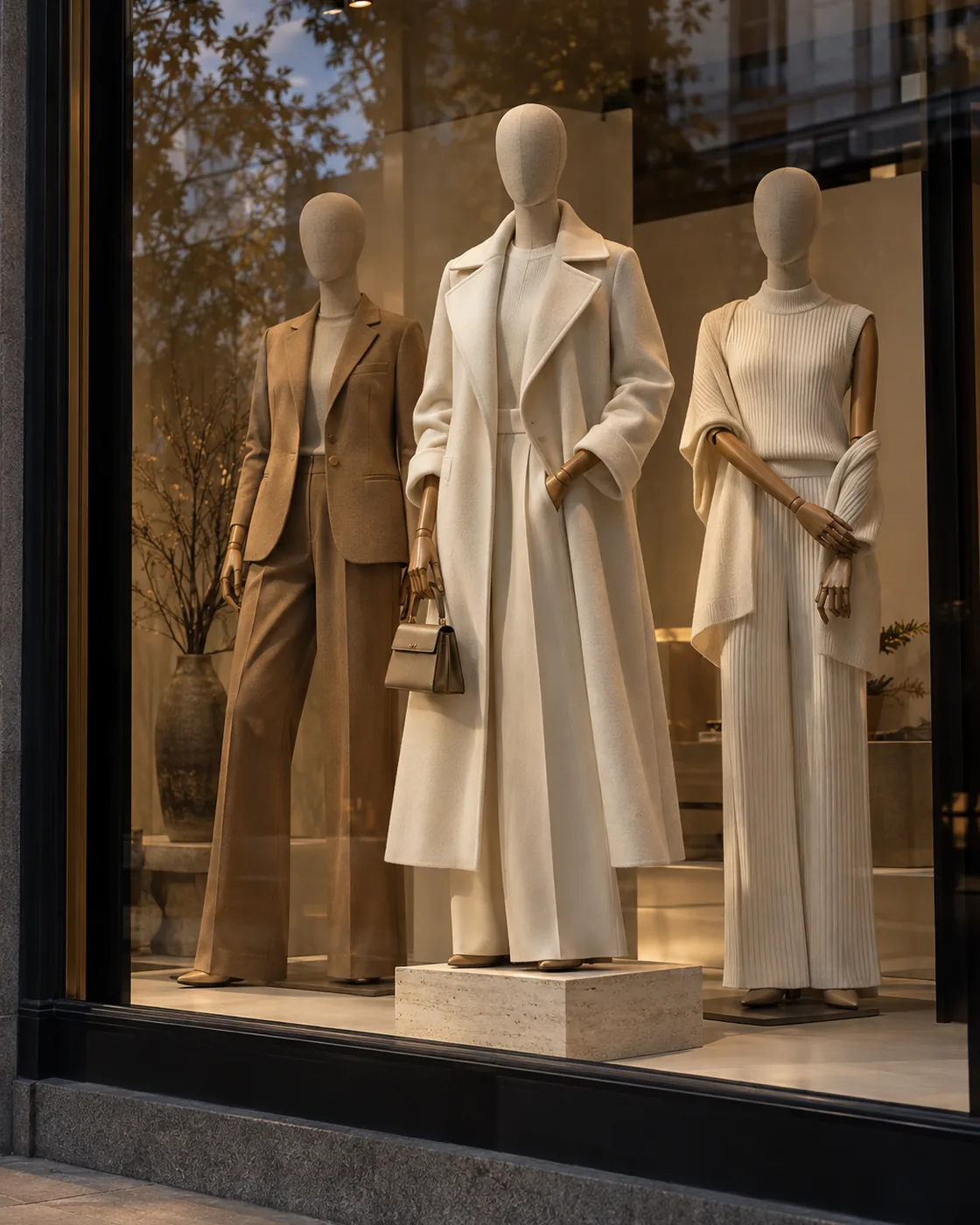
Window Display Mannequins: How to Choose Forms for Storefront Windows
What changes when a mannequin moves into the window: how to choose form type, fabric finish, posture and articulation for storefront display, and what to tell a manufacturer when ordering window forms.
A window works differently from the shop floor. Nobody in the street can touch the garment, read a label or ask a question. The display has a few seconds to make a passer-by stop, and the mannequin is the thing doing most of that work. A form that looks perfectly acceptable inside the store can look flat, small or cheap once it is standing behind glass under directional light.
This guide covers what changes when a mannequin moves into the window, how to choose the type, finish and posture for storefront use, and what to ask a manufacturer when you are ordering forms specifically for window display.
What makes a window different from the sales floor
Four conditions apply to almost every storefront window and none of them apply inside the store:
- Distance. Viewers stand two to five metres away, often walking. Fine detail disappears; silhouette, colour and posture are what register.
- Light. Windows are lit hard from above or the side, and daylight competes with it. Glossy surfaces flare and throw reflections back onto the glass; matte surfaces read cleanly.
- Exposure. Sun, heat and, in many climates, condensation reach the window long before they reach the floor. Finishes fade and adhesives soften.
- Change frequency. Windows are re-dressed far more often than floor displays — weekly in fast fashion, every few weeks in premium. Every change is a chance to damage a form.
Each of these pushes the specification in a particular direction, which is why window forms are worth choosing deliberately rather than pulling from general stock.
Choosing the mannequin type for a window
| Window situation | Usual choice | Why |
|---|---|---|
| Full-height window, complete looks | Full-body forms with articulated arms | Shows the whole outfit; arms can hold a bag, coat or accessory so the display tells a story |
| Shallow or low window | Torso or half-body forms on a raised base | Brings the garment to eye level without the depth a full-body form needs |
| Knitwear, shirting, layering | Torso forms in a group of three or five | Repetition of one silhouette reads strongly from the street |
| Accessories, eyewear, hats | Head forms and busts | Scale and detail are appropriate for small products |
If you are still deciding between torso and full-body forms in general, our comparison of half-body and full-body mannequins covers the trade-offs beyond the window.
Finish: why fabric-covered forms suit windows
The window is where the case for a fabric-covered mannequin is strongest. A linen or cotton surface does not reflect spotlights, so the garment stays the brightest thing in the composition. Fabric also carries colour with depth rather than shine, which photographs well through glass and holds up under mixed daylight and LED.
Fiberglass and lacquered forms are not wrong for windows — many brands use them well — but they need the lighting designed around them to avoid hotspots, and scuffs on a gloss surface show from the pavement. Our guide to fabric-covered versus fiberglass mannequins goes into the material differences in more detail.
Two practical notes on fabric in windows. First, choose the fabric colour against the backdrop, not against the garment: a cream form on a cream wall disappears from the street, while a warm grey or oatmeal form on the same wall gives the outfit an edge. Second, ask the manufacturer whether the fabric has been tested for sun fade. A window form in a south-facing shop sees more UV in a season than a floor form sees in years.
Posture and arms: making the window move
A static, symmetrical form is fine on the floor, where customers walk around it. In a window it reads as a shop dummy. What makes a storefront display look alive is asymmetry — a shifted hip, a turned head, one arm doing something.
This is where adjustable wooden arms earn their place. Jointed at the shoulder, elbow and wrist, they let the same form hold a handbag one week, tuck a hand into a pocket the next and carry a coat over the forearm the week after, without buying a different pose. For windows that change frequently, that flexibility is worth more than any single sculpted pose. Our guide to mannequins with wooden arms explains how the joints work and how to specify them.
Keep the set consistent, though. A window with one dynamic form and two rigid ones looks like a mistake. Either the whole group is articulated or none of it is.
Composition and hierarchy behind glass
The window is read as a single picture, so the forms need to be arranged as one. A few rules carry across almost every format:
- Give the display one hero. One form, slightly forward or raised, wears the piece you most want to sell. The others support it.
- Vary height. Risers, plinths and a mix of full-body and torso forms stop the eye sliding straight across.
- Turn the forms toward the traffic. A head or shoulder angled toward the direction people approach from pulls them in; a form facing dead ahead lets them pass.
- Leave space. Overfilled windows read as clearance. Premium brands often put fewer forms in a larger window and let the negative space do the work.
We cover the principles in depth in our guide to visual hierarchy in a window display and in our article on grouping and composition. Lighting is the other half of the picture; see the retail display lighting guide for how to light forms without glare on the glass.
Durability for frequent re-dressing
Because windows are changed so often, the wear points on a window form are the ones staff touch every time: arm joints, the neck or head fitting, and the base connection. When specifying forms for window use, ask about:
- How the arms detach and re-seat, and whether the joint hardware can be tightened or replaced on site.
- Whether the head, if removable, locates positively rather than resting in place.
- The base design — a glass or metal base plate is low-profile and stable, but check it can be repositioned by one person during a change.
- Whether the fabric can be spot-cleaned and, later, re-covered, so a form that has faded after two summers is refreshed rather than replaced.
Our guides to mannequin bases and stands and joints and fittings cover what durable construction looks like at each of these points.
How many forms, and how many spares
A window programme usually needs more forms than the window holds. Most brands keep at least one spare set so the next scheme can be dressed in the back room and swapped in during a single quiet hour, rather than leaving the window empty while staff dress forms in view of the street. Rotating two sets also halves the sun exposure each set receives. For planning quantities across seasons and stores, see our article on planning mannequin quantities.
Ordering window display mannequins from a manufacturer
When you brief a manufacturer for window forms specifically, the useful information is: the window dimensions and plinth height, the direction and type of light, how often the display changes, the backdrop colour, and the garment categories the forms will carry. With that, a factory can recommend a form height, arm configuration, fabric colour and base that will actually work behind your glass rather than in a generic showroom.
We make fabric-covered display mannequins with adjustable wooden arms for brands whose windows are their most visible marketing. If you are planning a window programme and want advice on form type, fabric or quantities, send us the window dimensions and a photograph through WhatsApp or the quote form and we will come back with a recommendation.