
How to Choose a Custom Mannequin Manufacturer
A B2B guide to choosing a custom mannequin manufacturer—how to assess factories, customization, MOQ, quality control and global shipping.
Choosing a custom mannequin manufacturer is a sourcing decision, not just a purchase. The right factory becomes a long-term partner that protects your brand image, holds sizing and finishes consistent across reorders, and ships reliably to your markets. The wrong one costs you in delays, mismatched batches and forms that do not fit your garments. This guide walks B2B buyers—fashion brands, retailers, visual merchandisers and wholesalers—through how to evaluate a supplier before you commit.
What a custom mannequin manufacturer actually does
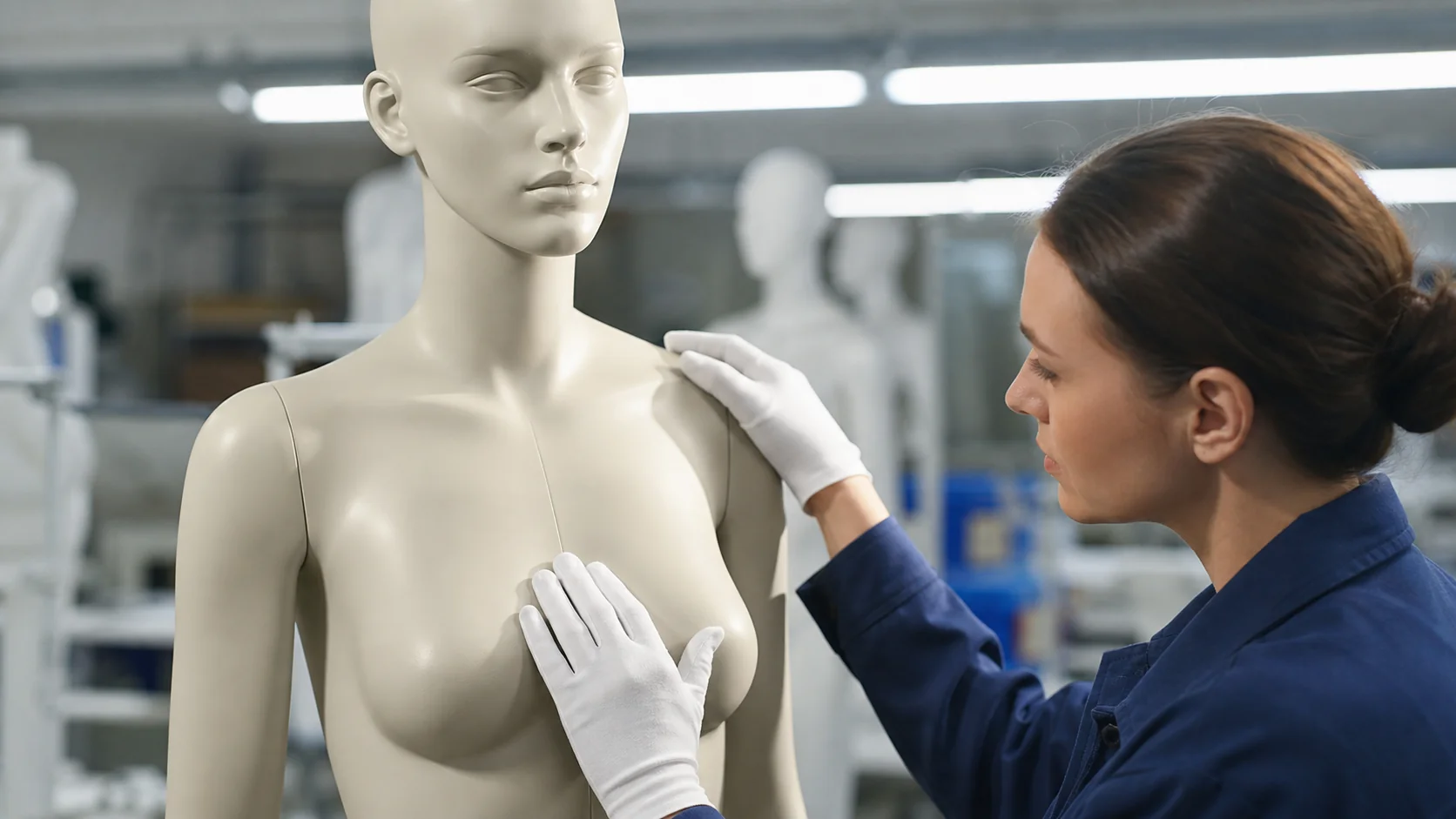
A true manufacturer controls the process end to end: sculpting or adapting body forms, producing the shell (fiberglass or other cores), covering it in fabric or applying finishes, fitting arms, bases and hardware, and running quality control before shipment. A trading company only resells. For custom work—your sizing, your fabric, your base and your branding—you want the factory that makes the product, because that is where customization, consistency and problem-solving happen.
The key criteria for choosing a supplier
1. Customization capability (OEM/ODM)
Ask what is genuinely adjustable: body proportions and poses, fabric type and color, arm style (wooden, painted, fabric or removable), base material and shape, and branding such as neck labels or logo plates. A capable partner offers both OEM (you provide the design) and ODM (they develop from your brief). If every answer is “standard only,” it is a catalog seller, not a custom manufacturer.
2. Materials and craftsmanship
Fabric-covered mannequins live or die on the covering: even tension, clean seams, colorfast fabric and a smooth base form underneath. Request close-up photos and, ideally, a sample. Consistent stitching, well-finished joints and stable bases are the signals of a factory that can repeat quality at volume.
3. Minimum order quantity (MOQ) and flexibility
MOQ determines whether a supplier fits your stage. A low, flexible MOQ lets you test designs before scaling; rigid high minimums tie up cash. Clarify MOQ per style versus per order, and whether mixed configurations count toward the same minimum.
4. Quality control
Ask how many checkpoints exist and what is inspected—form accuracy, fabric finish, base stability and packaging. A structured pre-shipment inspection with photos protects you from receiving a batch that does not match the approved sample.
5. Lead times and global shipping
Confirm sampling time, production lead time and packing method for export. Mannequins are bulky and fragile, so packaging and freight experience matter as much as the product. A partner used to shipping worldwide will advise on carton design, container loading and Incoterms.
6. Communication and project support
Custom projects need clear, fast communication across time zones. Responsiveness during the quotation stage is the best preview of how a supplier will behave once you have paid a deposit.
Questions to ask before you commit
- Are you the manufacturer or a trading company?
- What exactly can be customized—and what cannot?
- What is your MOQ, sampling time and production lead time?
- How do you control quality, and can I see pre-shipment photos?
- How do you package and ship mannequins internationally?
- Can you keep finishes and sizing consistent across future reorders?
Red flags to avoid
Be cautious of suppliers who cannot show real production photos, dodge questions about MOQ or customization, quote suspiciously low prices with no sample, or go quiet between messages. Any of these usually predicts trouble once an order is in progress.
Work with a manufacturer built for custom projects
XINTU is a Shenzhen-based manufacturer of custom mannequins and display forms for global fashion brands, retailers and visual merchandisers. We support full customization—fabrics, finishes, arms, bases and branding—with project-based cooperation, structured quality control and worldwide shipping. If you are planning a display program or developing a custom form, tell us your requirements and we will advise on the most suitable approach.
Get a quote or discuss your project: reach us by email or WhatsApp for a fast, no-obligation response.