
Velvet Mannequins: Choosing Pile, Color and Care for Retail Display
Choose velvet mannequins by pile direction, color, lighting and care, with practical checks for sampling, store handling and multi-store color consistency.
Velvet mannequins work best when the pile, color and lighting are approved together, on the finished form, under store lighting. Velvet gives a mannequin depth and a soft, premium surface, but it also shows direction, pressure and dust more readily than a flat linen or jersey cover. Plan for that from the sample stage and velvet becomes a dependable part of a display program rather than a maintenance problem.
This guide covers when velvet suits a brand, how the pile behaves on a three-dimensional form, how to choose and match colors, and how to keep velvet covers presentable through repeated dressing.
Key takeaways
- Approve velvet color on a finished form under your store lighting, not from a swatch.
- Check pile direction from every customer viewing angle; shading changes are most visible at shoulders, bust and hips.
- Choose arm and base finishes at the same time as the velvet color.
- Brush with the pile, avoid pins on the cover and store forms covered and upright.
- For multi-store orders, lock in a physical color standard and ask about single-batch production.
- XINTU reference: female forms 85 / 64.5 / 91 cm bust-waist-hip (180 cm full-body); MOQ 10 pcs per style; samples typically 1–3 weeks.
1. Decide what velvet should do for the display
Velvet is rarely a neutral choice. A richly colored cover reads as part of the styling, so it should support the collection rather than compete with it. It tends to suit:
- Boutique and luxury interiors, where a rich surface sits alongside wood, brass or stone. Our luxury and boutique mannequin guide covers the wider specification.
- Statement windows and campaign moments, where a colored body becomes part of the scene.
- Accessory and jewelry displays, where a dark velvet bust, head or hand frames metal and stones. See our guide to hand display stands for rings, bracelets and watches.
- Collections with simple silhouettes, where the body color adds interest without fighting prints.
Where garments carry busy prints, or the brand wants the body to recede, a flatter cover in a quieter shade is usually easier. Our guide to choosing mannequin fabric colors explains how to make that decision across a whole store.
2. Understand how the pile behaves on a form
Velvet has a raised pile that lies in one direction. Light reflects differently depending on whether the viewer looks along or against it, so the same cover can appear lighter or darker from different angles. On a flat panel that is easy to control; on a curved body, the pile turns with every seam and contour.
Ask your manufacturer how the cover is cut and how pile direction is kept consistent across panels, particularly at the shoulders, bust and hips, where shading changes are most visible. When you review a sample, walk around it and look from customer eye level and from the main approach to the display, not only straight on.
Seams deserve the same scrutiny. A well-cut velvet cover keeps seams in predictable positions and avoids puckering where the fabric is eased around tight curves. See how fabric-covered dress forms are made for the construction steps behind this.
3. Choose colors against the garments and the lighting
Velvet intensifies color. A red or green that looks restrained on a swatch card can look much stronger on a full-size form under spotlights. Approve color on a finished sample placed in, or close to, the real lighting.
- Deep tones such as green, blue, purple and burgundy frame light-colored garments and metallic accessories well.
- Soft tones such as pink or yellow suit lighter, seasonal or youthful collections.
- Multi-color sets can work in a group when the palette is planned as a whole; otherwise they quickly look accidental.
Lighting changes velvet more than most covers. Warm light deepens reds and yellows; cooler light can make greens and blues feel colder. A narrow beam emphasizes pile shading, while a broader wash softens it. Our retail display lighting guide and color in visual merchandising article help you test the combination before rollout.
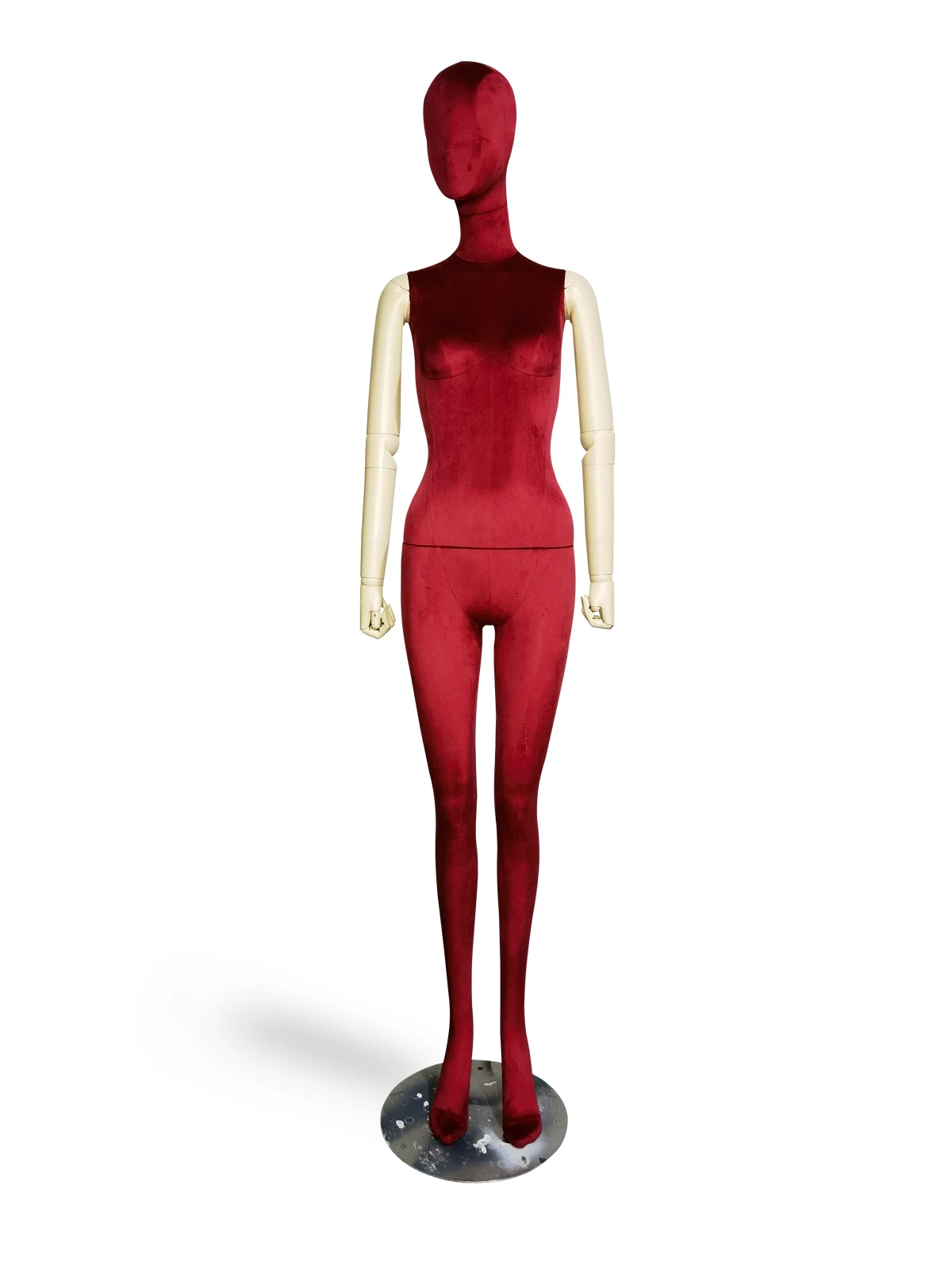
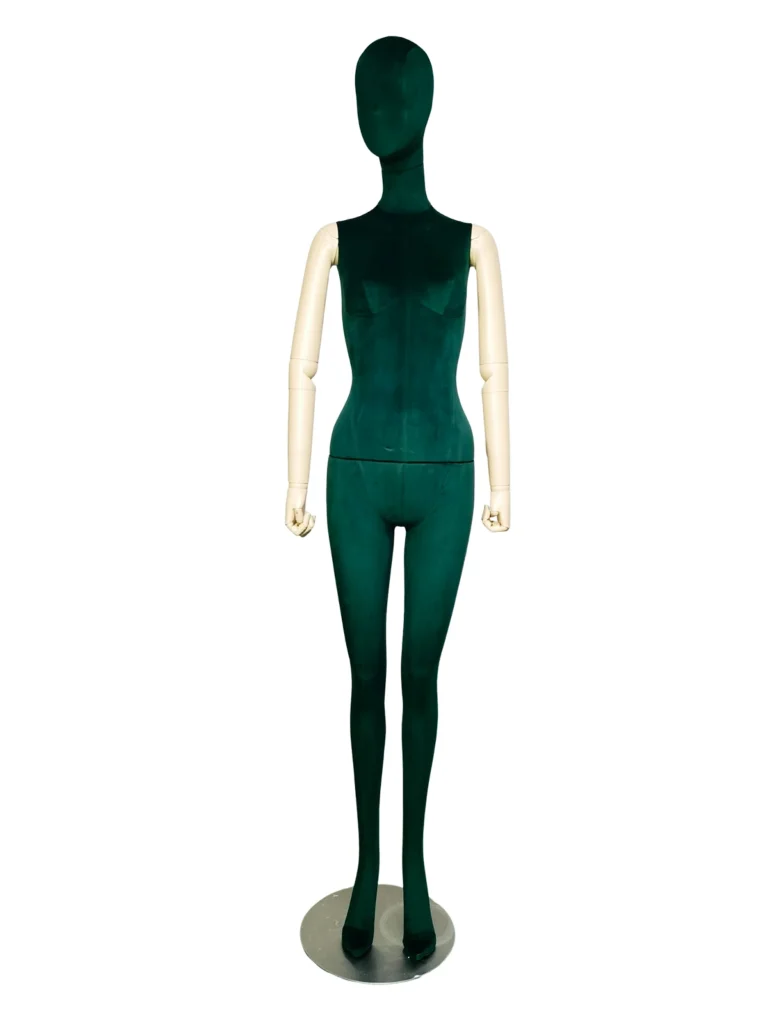
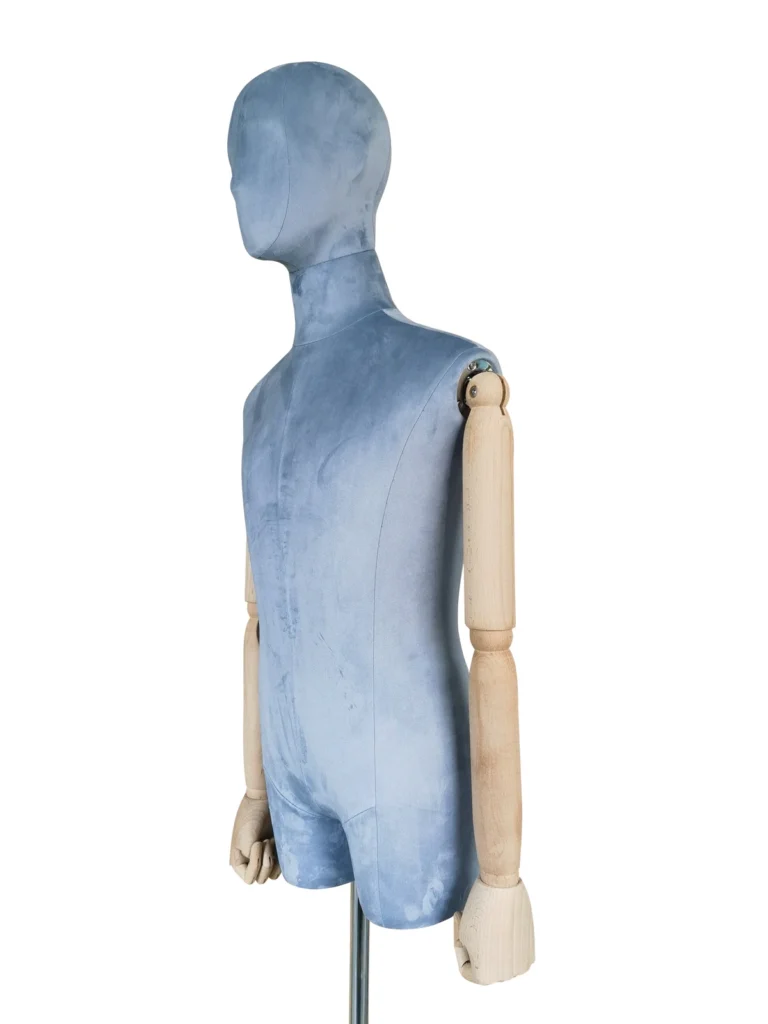
Examples in our range include the red velvet female full-body mannequin, the green velvet full-body version, the purple velvet half-body form, the pink velvet half-body form and the blue velvet male half-body mannequin.
4. Match arms, bases and heads to the velvet
Contrasting hardware is part of the velvet look. White painted arms make a colored body read more graphic; wooden arms feel warmer and more crafted; ABS arms are practical where arms are changed often. Decide the arm finish at the same time as the velvet color, because each changes how saturated the body appears. If you are considering wooden arms, our wooden arms guide covers articulation and finish.
Bases matter too. A metallic base adds formality; a natural wood or matte base keeps the look quieter. For accessory displays, a matching velvet display head can link hats or eyewear to a velvet-bodied mannequin nearby. Compare options in our bases and stands guide.
5. Plan for dressing, handling and care
Velvet shows pressure. Tight garments, hands, clips and pins can leave crushed areas, and dust and lint are more visible on dark pile. Build a few habits into store routines:
- Dress and undress carefully, lifting garments over the form rather than dragging them across the pile.
- Avoid pins and adhesive tape directly on velvet where possible; if fixing is unavoidable, agree acceptable positions with the supplier.
- Use a soft brush or a lint roller suited to pile fabrics, working with the pile direction.
- Keep velvet forms out of long periods of direct sunlight to reduce fading, especially in windows.
- Store forms covered and upright, with nothing heavy pressing on the body.
Light exposure is the main long-term risk for colored velvet. The Canadian Conservation Institute identifies UV in daylight as a major cause of dye fading and recommends displaying textiles under the lowest light level that still shows them well (CCI Note 13/1, Textiles and the Environment). Rotating window forms and using UV-filtering glazing can slow fading.
Our fabric mannequin cleaning guide and storage and handling guide give step-by-step routines. Always follow the supplier’s care instructions for the specific cover.
6. Order for consistency across stores
Velvet color can vary between fabric batches, and pile shading makes small differences more noticeable when forms stand side by side. For multi-store rollouts:
- Approve a physical color standard and keep a retained sample.
- Ask whether the full order can be produced from one fabric batch, and how reorders will be matched.
- Order spare covers or spare forms for the most visible locations.
- Record the approved color, arm finish and base reference for future orders.
For custom colors or brand-matched velvet, see our custom finishes guide.
XINTU velvet mannequin reference specifications
The figures below are the reference sizes listed on our product pages. All sizes are for reference only and can be fully customized.
| Model | Height | Shoulder | Bust | Waist | Hip |
|---|---|---|---|---|---|
| Female full-body (red / green velvet) | 180 cm (70.9 in) | 43 cm | 85 cm | 64.5 cm | 91 cm |
| Female half-body (purple / pink velvet) | Half body | 43 cm | 85 cm | 64.5 cm | 91 cm |
| Female seated (red velvet) | Confirmed per order | 43 cm | 85 cm | 64.5 cm | 91 cm |
| Male half-body (blue / green velvet) | Half body | 53 cm | 100 cm | 80 cm | 97 cm |
Order terms (from our product pages): MOQ is 10 pcs per style; pre-production samples are typically ready in 1–3 weeks; size, fabric, color, arms, base and branding can be customized; bulk orders ship by sea freight in export cartons, with air freight available for urgent samples. Pricing depends on size, material, finish and quantity.
Frequently asked questions
Is velvet harder to maintain than linen?
It needs more routine attention because dust, lint and pressure marks are more visible. With careful dressing, regular brushing and covered storage, velvet forms stay presentable through repeated use.
Why does my velvet mannequin look like two different colors?
Usually because of pile direction. Light reflects differently along and against the pile, so panels cut in different directions, or viewed from different angles, can appear lighter or darker.
Can velvet mannequins be used in windows?
Yes, and they often work well as statement pieces. Protect them from long periods of direct sunlight and check the color under the window lighting before approval.
Can I order a custom velvet color?
Custom colors are often possible, depending on fabric availability and order size. Approve a physical sample on a finished form before production.
What is the MOQ for custom velvet mannequins?
At XINTU the MOQ is 10 pcs per style. Pre-production samples are typically ready in 1–3 weeks, and color, size, arms and base can be customized.
What sizes are XINTU velvet mannequins?
Our reference female velvet forms measure 43 cm shoulder, 85 cm bust, 64.5 cm waist and 91 cm hip, with full-body versions 180 cm tall. The male half-body form measures 53 / 100 / 80 / 97 cm. All sizes can be customized.
Develop your velvet display program with XINTU
Share the garments, interior palette and lighting you are working with, and we can propose velvet colors, arm finishes and bases to sample together. Start with our custom mannequin service or contact our team. If you are planning a mix of body types, our half-body vs full-body guide is a useful next read.